Spryza · Kalahari Dried Microgreen Blends
2-3 gram

Your daily vitamins, minerals, phytonutrients — still in the food

A teaspoon of KVB added to any meal delivers the vitamins, minerals and phytonutrients your body recognises — because they never left the plant.

Kalahari Vital Blend

"I started adding KVB to my food every day. I haven't been sick since."

KVB user · Northern Cape
7.5% moisture — shelf-stable, no refrigeration
45°C max temp — nutrients stay intact
4 life-stage blends, one for every decade
The Complete System

Four blends, one for every life stage — designed as a single system, not four separate products.

KVB and KPB are shipping now. KEB-I and KEB-II complete the range later this year.

KVB
Vital · ≤35 years
Available now
KPB
Prime · 35–60 years
Available now
KEB·I
Elders I · 60+ years
Launching soon
KEB·II
Elders II · 60+ years
Launching soon

A multivitamin is an attempt to put back what food lost.

Study after study shows that isolated vitamins in a capsule don't behave the way vitamins in food do. The co-factors, enzymes, and fibre that help your body absorb them are gone.

KVB is a different answer. Instead of extracting nutrients from food and pressing them into a tablet, we dried the food at low temperature and kept everything in place. The vitamins, minerals, and phytonutrients are still where they were — in the plant matrix, the way your body knows how to use them.

That's not a supplement. That's food that did its job.

The combined benefit. The dried Kalahari blend and the phyto‑infused macadamia oil are designed as a single whole‑food system. While any oil can help absorb the fat‑soluble vitamins A, E, and K from the blend, our infused oil does far more. During the 8–12 day cold infusion, carotenoids, chlorophyll, flavonoids, and other protective phytonutrients are slowly extracted from the microgreens and dissolve directly into the oil. This means that when you drizzle the infused oil over your meal, you are not just adding a fat source to unlock the dried blend — you are adding a second, complementary layer of already‑dissolved plant compounds that require almost no digestive work to absorb. Plain oil simply carries; infused oil carries and contributes. Together, the blend and the infused oil deliver more of what the plant has to offer, in a form your body can use immediately.

Macadamia oil is 100% local (South Africa) sourced.

Standard multivitamin
KVB · Kalahari Vital Blend

Nutrients extracted, isolated, synthesised

Nutrients remain in the original plant matrix

Co-factors and enzymes removed in processing

Co-factors intact — dried below 45°C

Body must recognise and absorb synthetic forms

Food-form nutrients — already bioavailable

Taken separately from food

Added to any meal — part of the food


Environment friendly processess. Utelising the dry kalahari desert climate, sun drying for maximum retention and shelf life.

Preserving maximum of the vitamins, minerals and phytonutrients. Perfect for our natural phyto-infusion protocols.

Where did the nutrient go?

How It Works

Kalahari desert to your plate — four steps

01

Grown in South Africa

Microgreens harvested at peak nutrient density — before the plant redirects energy to roots and seeds. No pesticides. No synthetic fertilisers.

02

Hybrid Kalahari sun-dried

24–36 hours in a natural airflow chamber, then 4–6 hours in direct sun. Temperature never exceeds 45°C — the threshold above which heat-sensitive compounds break down.

03

Hand-crushed to 1–2mm

Dried to 7.5% moisture and hand-crushed, finished with a mild milling — not powdered. The coarse texture disperses evenly in food without disappearing into it.

04

Add to any meal

2-3g — about a level teaspoon — added after cooking. Stir into your food, shake over a salad, blend into a smoothie. Done.

Always add after cooking to avoid destroying the delicate vitamins.

The Collection

Four blends. One for every stage of life.

Each blend is formulated for a specific life stage — different nutritional priorities, different plant compositions. Choose the one that matches where you are.

≤ 35 years
KVB
Kalahari Vital Blend
40% Sunflower · 40% Yellow Pea · 20% Radish Cherry Belle
Key nutrients
Vitamin E · B1 · B3 · B6 · Folate
Magnesium · Zinc · Iron · Potassium
Linoleic acid · Phytosterols · Glucosinolates
35 – 60 years
KPB
Kalahari Prime Blend
30% Broccoli · 30% Yellow Pea · 20% Radish · 20% Mustard
Key nutrients
Vitamin C · K · E · B complex
Calcium · Magnesium · Selenium
Sulforaphane · Glucosinolates · Polyphenols
60+ years Launching soon
KEB·I
Kalahari Elders Blend I
35% Greenfeast Pea · 30% Yellow Pea · 25% Radish · 10% Garlic Chive
Key nutrients
Vitamin B1 · B6 · Folate · E
Iron · Zinc · Magnesium · Sulphur
Amino acids · Peptides · Allicin
60+ years Launching soon
KEB·II
Kalahari Elders Blend II
35% Greenfeast Pea · 28% Yellow Pea · 25% Radish · 12% Carentan Leek
Key nutrients
Vitamin B complex · E · K
Iron · Magnesium · Manganese
Flavonoids · Sulphur compounds · Polyphenols
What's inside

A natural source of vitamins, minerals and phytonutrients

The nutrient profile below reflects published data for the specific microgreen varieties used in our blends. Exact levels vary by batch, season and growing conditions — as they do in any whole food.

What stays consistent is the process: dried below 45°C, no synthetic additives, no preservatives.

Based on published nutritional data for the microgreen varieties used, including Turner, E.R., Luo, Y., & Buchanan, R.L. (2020). Microgreen nutrition, food safety, and shelf life: A review. Journal of Food Science, 85(4), 870–882. Pending direct analytical confirmation per batch. These are natural food products — not medicines. No therapeutic claims are made.
Vitamins — naturally present
Vitamin A Vitamin C Vitamin E Vitamin K₁ Thiamin B₁ Riboflavin B₂ Niacin B₃ Pantothenic Acid B₅ Vitamin B₆ Folate B₉
Minerals — naturally present
Calcium Iron Magnesium Phosphorus Potassium Zinc Manganese Copper Selenium trace
Phytonutrients — what a pill can't replicate
Sulforaphane Glucosinolates Carotenoids Chlorophyll Flavonoids Allicin Phytosterols Phenolic Acids Prebiotic Fibre Myrosinase enzyme
🔬 Science at a Glance

Natural vitamin E is retained in the body roughly twice as long as the synthetic form found in most pills — the vitamin E in our sunflower microgreens is the natural form your body holds onto.

Burton, G.W., Traber, M.G., Acuff, R.V., et al. (1998). Human plasma and tissue α-tocopherol concentrations in response to supplementation with deuterated natural and synthetic vitamin E. American Journal of Clinical Nutrition, 67(4), 669–684. pubmed.ncbi.nlm.nih.gov/9537614

At high doses, the gut cannot absorb all the vitamin C in a pill — a 1000 mg single dose delivers only about half of what it promises. Spryza provides modest, physiological doses your body can actually use.

Levine, M., Conry-Cantilena, C., Wang, Y., et al. (1996). Vitamin C pharmacokinetics in healthy volunteers: evidence for a recommended dietary allowance. Proceedings of the National Academy of Sciences, 93(8), 3704–3709. pubmed.ncbi.nlm.nih.gov/8623000

Whole-food vitamin C arrives alongside natural bioflavonoids — every teaspoon of our blend delivers vitamin C inside the intact plant matrix, exactly as nature intended.

Carr, A.C., & Vissers, M.C.M. (2013). Synthetic or food-derived vitamin C — are they equally bioavailable? Nutrients, 5(11), 4284–4304. pubmed.ncbi.nlm.nih.gov/24169506

Synthetic folic acid requires hepatic conversion before it becomes metabolically active — natural food folate does not. The folate in our pea and radish microgreens needs no conversion step.

Bailey, L.B., & Gregory, J.F. (1999). Folate metabolism and requirements. Journal of Nutrition, 129(4), 779–782. pubmed.ncbi.nlm.nih.gov/10203550

Carotenoids (vitamin A precursors) from plants are poorly absorbed unless accompanied by dietary fat — that's why our cold-infused macadamia oil matters: it provides the fat needed to help unlock these nutrients.

Castenmiller, J.J.M., & West, C.E. (1998). Bioavailability and bioconversion of carotenoids. Annual Review of Nutrition, 18, 19–38. doi.org/10.1146/annurev.nutr.18.1.19

The health benefits of fruit and vegetables are thought to come from thousands of phytochemicals acting together, not from any single isolated vitamin — Spryza delivers vitamins, minerals, fibre, enzymes, and phytonutrients together, as they occur in the plant.

Liu, R.H. (2003). Health benefits of fruit and vegetables are from additive and synergistic combinations of phytochemicals. American Journal of Clinical Nutrition, 78(3 Suppl), 517S–520S. pubmed.ncbi.nlm.nih.gov/12936943

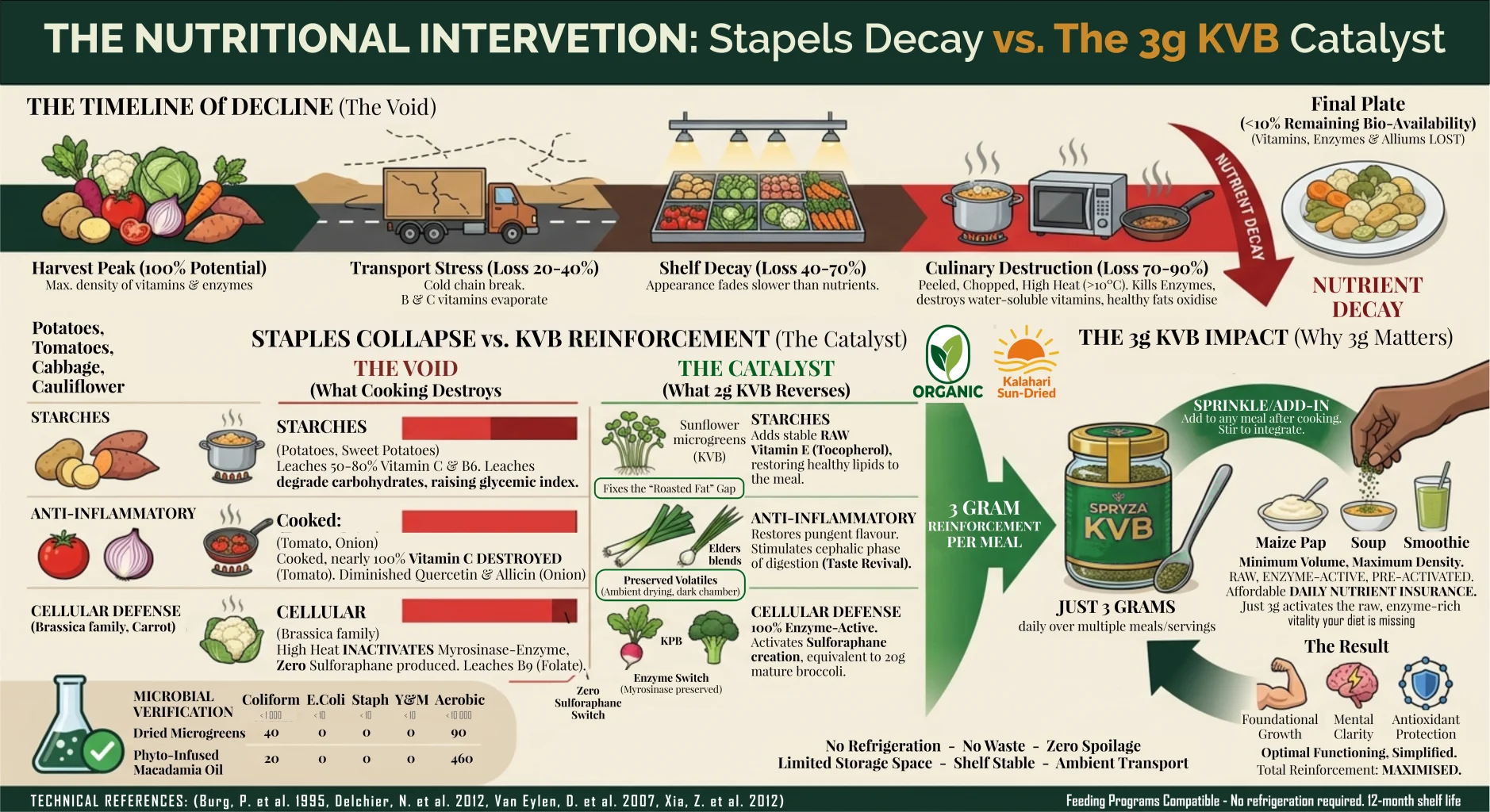
Four ways to use it

Add It to What You Already Eat

01 · Food

Stir into any dish

Add 2-3g after cooking — once the food is off the heat. Stir in. That's it. Works in everything from pap to pasta, eggs to soup.

02 · Smoothie

Blend in the morning

Add 2-3g to any smoothie. No taste interference. You get the nutrients without changing what you're already drinking.

03 · Dressing

Make it a condiment

Mix into a salad dressing with our Phyto-Infused Macadamia Oil — the oil carries the phytonutrients and adds its own nutritional profile.

04 · N8 Shot

The Neuro-Shot

3g KVB · 15ml macadamia oil · 3ml lemon juice. One shot before a long shift. Designed for students, drivers, guards, and anyone running on a demanding schedule.

🌡️

Addafter cooking, below 70°C. Heat above this threshold breaks down the enzyme activity that makes microgreens nutritionally valuable. Add at the table, not at the stove.

Who built this

Built in the Kalahari. Because the food system wasn't working.

The problem isn't effort — it's that by the time a potato or a carrot reaches your plate, a significant portion of its nutritional value is already gone. Picked too early, stored too long, cooked at temperatures that finish the job.

Spryza is my answer to that. Grow microgreens at peak nutrient density. Dry them at low temperature before the plant degrades. Add 2-3g to what you're already eating. The nutrition stays in the food — because we never let it leave.

Japie Founder, Xeric Farms and Spryza Deben, Northern Cape, South Africa
"I started adding KVB to my food every day. I haven't had cold or the flu since."
KVB user · Northern Cape · unsolicited feedback

3rd-party microbial testing — Coliform 40, E.Coli 0, Staph 0, Yeast & Mould 0 · February 2026

Hybrid sun-dried process — 24–36 hours airflow, 4–6 hours direct sun. No artificial heat.

VertiGrow Farmers Association partner network — 17 farms across 7 provinces

No pesticides. No synthetic fertilisers. No preservatives. No refrigeration needed.


The process

Why low temperature matters — and what it changes

Most commercial food processing applies heat to extend shelf life. Heat kills microbes — but it also destroys a category of plant compounds that can't survive above 70°C. Enzymes like myrosinase (which activates sulforaphane in broccoli) and allicin (the active compound in garlic) are heat-sensitive. Once they're gone, they're gone.

Our hybrid sun-drying process removes upto 93% of moisture through ambient airflow before a final direct-sun finishing step. The result is a shelf-stable product that doesn't need refrigeration — but hasn't been cooked.

1
Harvest at peak Microgreens cut at the cotyledon stage — nutrient concentration is highest before the plant matures
2
Airflow chamber 24–36 hours in a dark chamber with 16W fan per 8-rack section. Ambient temperature. No artificial heat.
3
Direct sun finish 4–6 hours direct sun. Takes moisture to 7.5% — shelf-stable without refrigeration.
4
Hand-crushed to 1–2mm, finished with a mild milling Not powdered. The coarser texture preserves cell structure and disperses evenly in food.
5
Packed and sealed 40g reuseable glass jar or zip-lock refill pouch. No preservatives. Tested for microbial safety.

A note on claims: Spryza blends are whole food products — a natural source of vitamins, minerals and phytonutrients as they occur in plants. We make no therapeutic or medicinal claims. These products are not intended to diagnose, treat, cure or prevent any disease. Statements on this site have not been evaluated by SAHPRA.

Start today

Two-Three grams. Any meal. Every day.

Pick your blend based on your life stage. Add it to whatever you're already eating. That's the whole habit.